






To use fentanyl test strips: 1) Gather all supplies including strips, clean container, and water. 2) Prepare a clean testing area. 3) Measure 10mg of substance. 4) Mix with 5mL of water. 5) Dip the strip for recommended time. 6) Wait 5 minutes. 7) Interpret results (one line=negative, two lines=positive). 8) Document findings. 9) Dispose of materials safely. 10) Develop a safety plan if fentanyl is detected. These simple steps could save your life.
Gather Your Testing Materials and Supplies
To begin testing for fentanyl, you’ll need five essential items: fentanyl test strips, a clean water source, a small container for mixing, a timer, and disposable gloves. Make sure your testing supplies are all within reach before starting the process. The test strips should be stored according to manufacturer instructions, typically in a cool, dry place away from direct sunlight.
For ideal preparation, use a clean, clear container that allows you to see the liquid clearly. Bottled water works best as your clean water source, though tap water is acceptable if it’s not heavily chlorinated. Always wear gloves during the entire testing process to prevent any accidental skin contact with substances. Keep your timer nearby, most smartphones have this function, as timing accuracy is vital for correct results.
Prepare a Clean Testing Environment
Begin by wiping down your testing surface with alcohol or disinfectant to eliminate any potential contaminants that could affect your results. Arrange your test strips, gloves, clean containers, and other materials within easy reach but separate from each other to prevent cross-contamination. Keep the area well-lit and away from food, drinks, or high-traffic zones where accidental exposure might occur.
Sanitize Your Work Area
Three critical steps guarantee your testing environment remains contamination-free. Proper workspace cleanliness isn’t optional when testing for fentanyl, it’s essential for accurate results and your safety. Even microscopic contaminants can trigger false positives or negatives, potentially leading to life-threatening decisions.
- Wipe your surface with isopropyl alcohol (70% or higher) using a clean paper towel or sterile wipe, moving in one direction rather than circular motions that spread contaminants
- Allow the surface to air dry completely, don’t wipe it dry as this reintroduces particles from the towel
- Wash your hands thoroughly with soap and warm water for at least 20 seconds, paying special attention to areas under fingernails where residue often hides
These sanitization techniques create a reliable testing environment that enhances accuracy.
Gather Needed Supplies
Seven essential items must be assembled before you begin testing for fentanyl. Your supply checklist should include: 1) fentanyl test strips (FTS), verifying they’re unexpired; 2) a clean container for mixing; 3) distilled water (never tap water); 4) a timer or stopwatch; 5) disposable gloves to prevent contamination; 6) a clean, flat surface covered with paper; and 7) a disposal bag for used materials.
Keep these essential items together in a dedicated testing kit for convenience and safety. If you’re testing substances regularly, consider purchasing supplies in bulk to guarantee you’re never caught unprepared. Bear in mind that accurate testing depends on having the proper equipment ready before you start. Missing even one component might compromise your results or create unnecessary exposure risks.
Avoid Cross-Contamination Risks
Four critical steps must be taken to prevent cross-contamination when testing for fentanyl. Cross contamination sources include previously used surfaces, unwashed hands, or contaminated testing materials. Establish a clean testing environment precautions by initially washing your hands thoroughly with soap and water.
- Designate a specific, clean area for testing that’s away from food, beverages, or high-traffic locations where airborne particles might settle
- Cover your testing surface with a fresh piece of aluminum foil, clean paper, or a disposable plate that hasn’t been exposed to substances
- Use separate testing tools (straws, razor blades, etc.) for each test to eliminate the risk of false positives from residue
Remember that even microscopic amounts of fentanyl can affect test results and potentially cause harm.
Identify the Correct Amount of Substance for Testing
Identifying the correct amount of substance for testing is critical for accurate fentanyl detection results. You’ll need a sample roughly the size of a matchhead (about 10mg), as too much substance can overwhelm the test and produce false negatives while too little may not register properly. Measure your sample carefully using a clean surface and tools, ensuring you’re working with the ideal amount recommended by the test strip manufacturer.
Measure With Precision
Precise measurement stands as the cornerstone of accurate fentanyl testing. When preparing your sample, use exactly 10mg of powdered substance or a tiny fragment (approximately rice-grain sized) of a pill or tablet. Testing accuracy depends entirely on following these measurements, too much substance can overwhelm the test, while too little may not provide sufficient material for detection.
To guarantee sample integrity:
- Use a digital milligram scale (0.001g precision) to weigh powder substances exactly, placing the sample on a small piece of clean paper rather than directly on the scale.
- For pills, use a clean razor blade to carefully scrape or cut the correct amount from different parts of the tablet.
- Photograph your measured sample next to a common reference object before testing to document your process.
Too Much Versus Enough
The balance between too much and too little substance creates the difference between reliable results and false readings. You’ll need approximately 10mg of powder or a few grains of crushed pills for best testing, about the size of a match head. For liquids, use no more than 5-10 drops.
Exceeding the recommended amount can overwhelm the test strip’s threshold detection capability, potentially causing false negatives even when fentanyl is present. Conversely, insufficient sample quantity might not reach the minimum threshold detection level required for accurate results.
These dosage implications directly impact your safety. Keep in mind that test strips detect presence, not concentration levels. Always err on the side of using the manufacturer’s recommended amount, typically indicated on the packaging, to guarantee the most accurate detection possible.
Optimal Sample Size
Accuracy depends entirely on using the right quantity of substance for your fentanyl test. Too much material can overwhelm the strip’s detection capabilities, while too little might miss traces of fentanyl completely. The ideal sample size guarantees maximum testing accuracy.
Follow these guidelines when measuring your sample:
- Use approximately 10mg of powder (about the size of a match head) or a small fragment of a pill crushed into powder.
- For liquid samples, draw up exactly 10 drops using a clean dropper.
- When testing residue from smoking equipment, collect a visible amount of residue using a clean, dry cotton swab.
Remember that consistent sample size across multiple tests allows for reliable comparisons if you’re testing different batches of the same substance.
Properly Dilute Your Sample With Water
Proper dilution stands as the most critical step when testing substances for fentanyl contamination. For powders and pills, mix 10mg (roughly the size of a match head) with approximately 1 teaspoon (5mL) of clean water in a small container. Different dilution techniques apply to diverse substances, ensure your sample consistency resembles that of weak coffee or tea.
For tar heroin or sticky substances, use slightly more water to achieve proper dissolution. Stir thoroughly until completely mixed, as undissolved particles can affect test accuracy. If your sample won’t dissolve completely, allow it to settle, then test the liquid portion.
Never use more substance than recommended, over-concentrated samples may cause false negatives. Conversely, excessive dilution can make fentanyl undetectable. Always measure carefully and maintain consistent ratios for reliable results.
Insert the Test Strip Correctly
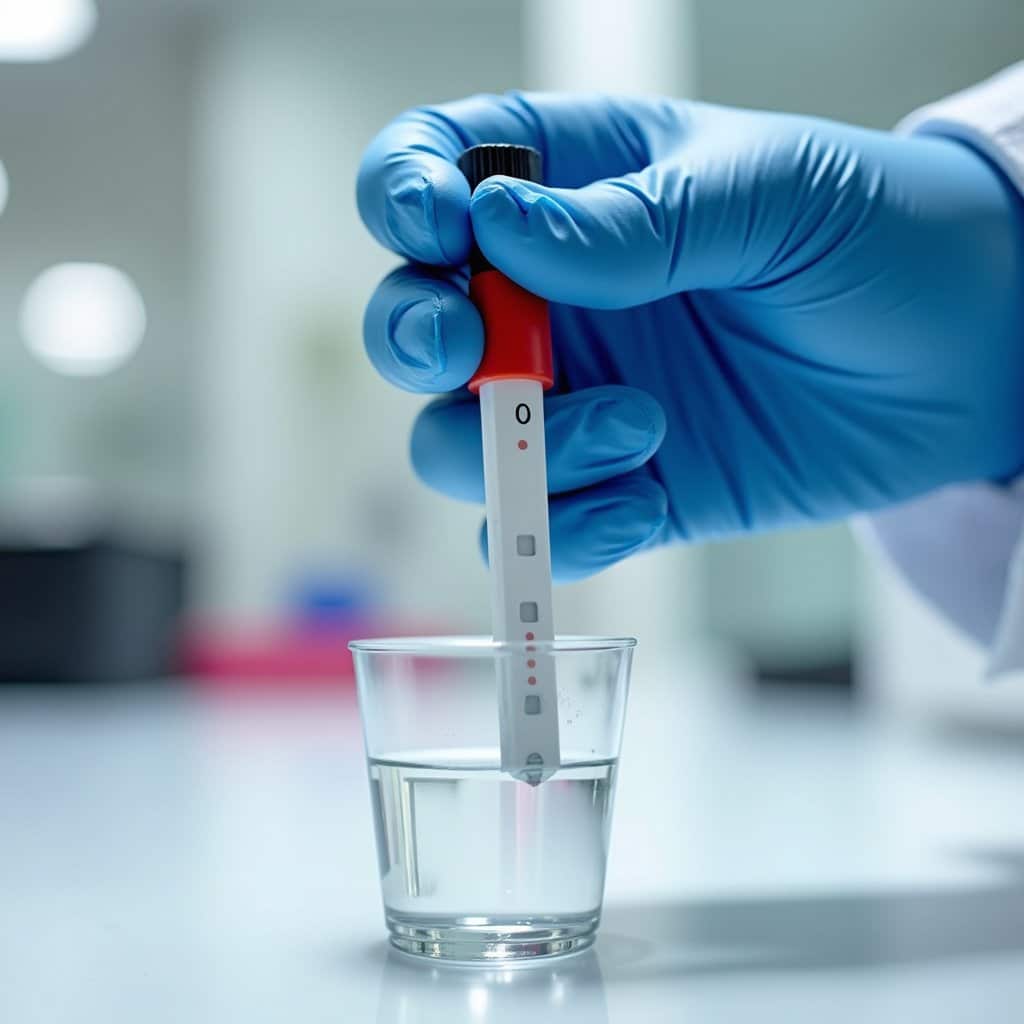
When inserting the test strip, always hold it by the designated handle area to avoid contaminating the test region. The direction of insertion matters critically, follow the arrows printed on the strip and guarantee the test lines are positioned as indicated in the instructions. Never touch the test area with your fingers, as oils and residues can interfere with the chemical reaction and potentially produce inaccurate results.
Hold Strip by Handle
The single most vital aspect of handling a fentanyl test strip is to hold it only by the designated handle. Proper strip handling techniques prevent contamination that could lead to false results. The handle is typically the blue or colored end of the strip, designed specifically as the grip area.
- Position your thumb and index finger to pinch only the colored handle portion, guaranteeing your skin never contacts the absorbent test area.
- Maintain this proper grip throughout the entire testing process, even when removing the strip from its packaging.
- Hold the strip vertically when inserting it into the testing solution to prevent splashing and guarantee the liquid travels up the strip correctly.
Remember that touching the test area with your fingers can transfer oils and contaminants that compromise accuracy.
Direction Matters
Since incorrect insertion can invalidate your results, you’ll need to confirm proper orientation of the fentanyl test strip when testing your substance. The direction influence on testing accuracy cannot be overstated.
Most strips have a clearly marked end labeled “MAX” or display arrows indicating the proper insertion direction. Always insert the strip with this marked end going into the solution initially, up to but not exceeding the maximum line. Never submerge the entire strip, including the handle area, as this may compromise results.
If your strip doesn’t have clear markings, refer to the manufacturer’s instructions. Keep in mind that improper orientation can lead to false results, potentially putting lives at risk. Consistent, correct insertion technique guarantees reliable detection of fentanyl contamination.
Avoid Touching Test Area
Handling your test strip correctly represents one of the most critical steps in the testing process. Oils and residues from your fingers can contaminate the test area, potentially leading to false results. Proper handling guarantees test area hygiene and maintains the strip’s sensitivity to detect even trace amounts of fentanyl.
- Hold the strip only by the blue end – this is the designated handling area designed specifically for your fingers
- Keep the absorbent test area completely untouched – even minimal contact with skin oils can compromise results
- If accidentally touched, discard the strip and use a new one – contaminated strips cannot be cleaned or salvaged
Remember that proper handling isn’t just about accuracy, it’s about safety. Reliable results depend on maintaining test strip integrity throughout the entire process.
Wait the Required Detection Time

After dipping the test strip in the solution, you’ll need to wait for the recommended detection time for accurate results. Most fentanyl test strips require a waiting period of 5 minutes, no more, no less, for ideal testing accuracy. During this time, place the strip on a clean, flat surface where it won’t be disturbed.
Don’t rush the process by checking results too early, as this could lead to false readings. Likewise, waiting too long (over 10 minutes) might invalidate the test. Keep track of time using a timer on your phone rather than guessing. The detection time is essential for allowing the chemical reaction to fully develop on the strip. While waiting, avoid touching the strip or exposing it to excessive moisture, heat, or direct sunlight that could interfere with results.
Read and Interpret the Test Results
The correct interpretation of fentanyl test results is essential for harm reduction. After waiting the required time, examine the strip carefully to perform accurate result analysis. The test interpretation is straightforward: one line means positive for fentanyl, while two lines indicate negative results.
Accurate fentanyl test interpretation saves lives. Remember: one line means positive, two lines indicate negative.
- Look at the test zone (marked “T”) and control zone (marked “C”) – a visible line must appear in the control zone for a valid test.
- Observe the test line’s appearance – even a faint line in the test zone counts as negative for fentanyl.
- Document your results in a well-lit area – take a photo if needed for reference.
Remember that false negatives can occur. If you’re uncertain about your test interpretation, it’s safer to assume fentanyl is present or test again with a new strip.
Understand the Limitations of Test Strips
While fentanyl test strips provide valuable information, they have significant limitations that users must recognize for safety. Test strip accuracy isn’t perfect, they can’t detect all forms of fentanyl or its analogs, potentially giving false negatives. Newer synthetic opioids might go undetected despite being similarly dangerous.
Substance variability presents another challenge. Drugs can be unevenly mixed, meaning the portion you test might be fentanyl-free while another portion contains a lethal dose. Moreover, these strips don’t indicate the concentration of fentanyl present, even a positive result doesn’t tell you how much is in your sample.
Never assume a negative result guarantees safety. Always practice harm reduction strategies like using with others, starting with small amounts, and having naloxone available.
Safely Dispose of Used Testing Materials
Proper disposal of fentanyl test materials requires three essential steps to minimize health hazards and environmental contamination. Responsible disposal prevents accidental exposure to residual substances and reduces environmental impact in landfills and water systems.
- Place all used materials, test strips, containers, and mixing tools, into a sealable plastic bag immediately after testing is complete.
- Add a household deactivating agent like bleach, coffee grounds, or kitty litter to the bag to neutralize any remaining substances.
- Seal the bag tightly, label it as “hazardous waste,” and dispose of it according to your local hazardous waste guidelines, never in standard household trash or toilet.
Contact your community’s waste management department for specific disposal regulations if you’re uncertain about proper procedures in your area.
Develop a Safety Plan Based on Results
After safely discarding testing materials, you must prepare for what comes next if fentanyl is detected. Your safety plan should include always using with someone present who isn’t also using. Keep naloxone (Narcan) nearby and make certain everyone knows how to administer it if an overdose occurs.
Establish specific safety protocols: start with a small test dose if you choose to use, wait at least 30 minutes before taking more, and never mix substances. Avoid using alone by implementing a buddy system or virtual supervision through video calls.
Store emergency contacts in an easily accessible location. Program numbers for poison control (1-800-222-1222), trusted friends, and local harm reduction services into your phone. Consider downloading overdose response apps that can alert others if you become unresponsive.
Frequently Asked Questions
Where Can I Legally Purchase Fentanyl Test Strips?
You can legally purchase fentanyl test strips from multiple sources. They’re available through online retailers like DanceSafe, Amazon, and harm reduction websites. Local pharmacies may also carry them, though availability differs by region. Some public health departments distribute them for free. Check your state’s laws, as legality varies across the U.S. Remember, these strips are harm reduction tools designed to help prevent overdoses by detecting fentanyl in substances before consumption.
How Accurate Are Fentanyl Test Strips?
Fentanyl test strips are generally reliable when used correctly, with accuracy rates of 96-100% for detecting fentanyl specifically. However, accuracy factors include proper sample dilution, following testing methods precisely, and understanding limitations with newer analogs. You’ll get more accurate results by testing multiple samples from your substance, as distribution may be uneven. Remember, these strips can’t detect quantity or potency, they only indicate presence or absence of fentanyl compounds.
Can Test Strips Detect All Fentanyl Analogues?
No, fentanyl test strips can’t detect all fentanyl analogues. While they’re designed to identify many common forms, their testing limitations are significant. Some newer analogues may go undetected because they have different chemical structures that the strips aren’t calibrated to recognize. You should view test strips as just one harm reduction tool, not a guarantee of safety. Always exercise caution, as a negative result doesn’t mean your substance is completely free of all fentanyl-related compounds.
How Long Do Fentanyl Test Strips Remain Valid Before Expiring?
Fentanyl test strips typically remain valid for 1-2 years from manufacture when properly stored. Always check the expiration dates printed on your test strip packaging, as effectiveness diminishes after this period. Store your strips in a cool, dry place away from direct sunlight and extreme temperatures to maintain their accuracy. Never use expired test strips, as they may produce false negatives that put you at risk. Proper storage extends shelf life and guarantees reliable results when you need them most.
Can I Reuse a Fentanyl Test Strip?
No, you cannot reuse fentanyl test strips under any circumstances. Each strip is designed for single use only, which is one of the key test strip limitations to be aware of. Once the strip has been exposed to a substance, its chemical reactivity is permanently altered. Attempting fentanyl strip reuse won’t provide accurate results and could lead to dangerous false negatives. Always use a fresh test strip for each new substance you’re testing to guarantee reliability.